Hyundai i20 Review & Prices
It’s fun to drive and comes with a peppy engine, but the Hyundai i20 isn’t very comfortable and the interior is a bit bland

- Cash
- £18,133
- Monthly
- £210*
- Used
- £8,799

What's good
What's not so good
Find out more about the Hyundai i20
Is the Hyundai i20 a good car?
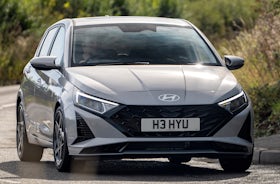
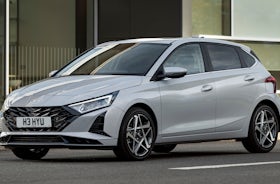
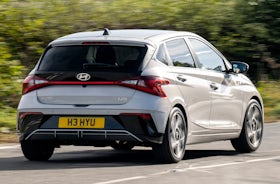
The Hyundai i20 is a small, handsome and fun-to-drive hatchback, and it’s one of the few petrol-powered, manual gearbox-equipped examples of the breed left on sale. It’s not very comfortable, though, and the interior isn’t as interesting as in alternatives.
You can think of it as that mate who’s properly into running, and it’s become a part of their personality. The i20 is sportier than its alternatives, but sometimes you wish it would just settle down into a relaxed cruise.
No, for that you’d need to look at the Volkswagen Polo, Vauxhall Corsa and Renault Clio, or even in-house with the mechanically similar Hyundai Bayon small SUV. There are some compelling electric small cars to choose from too, such as the Renault 5, Fiat Grande Panda or the Hyundai Inster.
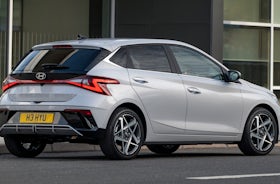
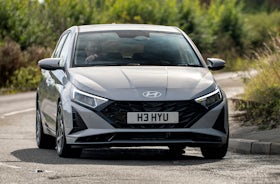
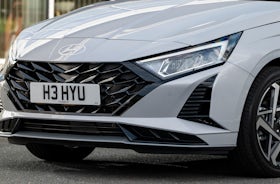
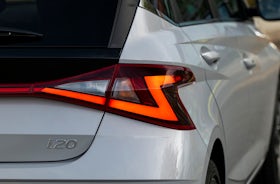
None look quite as sporty as the i20, though. If you squint and take several steps back, there’s even a hint of last-generation Audi to its styling; swept-back headlights straddling the hexagonal grille, and the C-shaped ends of the lightbar at the back.
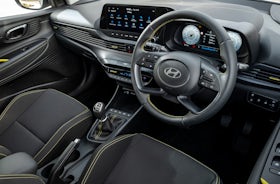
Shame the interior is so bland by comparison, even though you can see Hyundai’s designers have put a bit of effort in to lift the ambience. There are strakes running the width of the dashboard, door cards and even around the door handles, but you’re stuck with two colour choices in the i20: all black or a black and light-grey combo, both of which look cheap.
Even top-spec Tech Line cars with lime-green stitching and accents do little to help, but at least it’s spacious inside, while the push-button climate controls and 10.3-inch infotainment display are easy to use. The back seats are generous for a car of this size, and the boot is roughly on par with a Volkswagen Polo or Peugeot 208. A Renault Clio can carry far more junk in its trunk, however.
The Hyundai i20 is a very good all rounder as far as small cars go, but its cheap-feeling interior lets it down
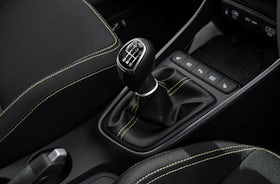
The 90hp, 1.0-litre petrol engine comes with a six-speed manual or seven-speed automatic gearbox. It’s not a particularly interesting unit, but it thrums along like a sewing machine when accelerating, which is quite fun. The manual gearbox is easy to row through, though the automatic is more relaxing around town.
Speaking of which, the i20 is a doddle to drive in urban areas. The light steering and peppy engine make it easy to navigate traffic lights and tight corners. The back pillars are a bit thick, but a standard-fit rear-view camera takes the stress out of parking.
You get jostled over speedbumps and potholes, though. The i20 doesn’t really settle down on the motorway, either, but the upside of the stiff suspension is made clear on a twisty road. The little Hyundai takes bendy lanes in its stride, and while it’s not a hot hatch, you can still have a giggle carving through corners.
Browse through the latest Hyundai i20 deals, or i20 lease deals, on Carwow. There are loads of used i20 deals to choose from, too, and other used Hyundais for sale through our trusted dealer network. Don’t forget, you can sell your current car through Carwow, too, when the time comes to switch.
How much is the Hyundai i20?
The Hyundai i20 has a RRP range of £20,010 to £26,515. However, with Carwow you can save on average £2,878. Prices start at £18,133 if paying cash. Monthly payments start at £210. The price of a used Hyundai i20 on Carwow starts at £8,799.
Compare Hyundai i20 trims and prices:
| Hyundai i20 trim and price | |
|---|---|
| 1.0T GDi 90 Element 5dr - Price from £20,010 |
Explore latest deals
|
| 1.0T GDi Advance [Nav] 5dr - Price from £22,365 |
Explore latest deals
|
| 1.0T GDi 90 Element 5dr DCT - Price from £21,260 |
Explore latest deals
|
| 1.0T GDi Premium 5dr - Price from £23,515 |
Explore latest deals
|
| 1.0T GDi Advance [Nav] 5dr DCT - Price from £23,615 |
Explore latest deals
|
| 1.0T GDi Ultimate 5dr DCT - Price from £26,265 |
Explore latest deals
|
| 1.0T GDi N Line S 5dr - Price from £25,015 |
Explore latest deals
|
| 1.0T GDi Premium 5dr DCT - Price from £24,765 |
Explore latest deals
|
| 1.0T GDi N Line S 5dr DCT - Price from £26,265 |
Explore latest deals
|
| 1.0T GDi Ultimate 5dr - Price from £25,015 |
Explore latest deals
|
The Hyundai i20 isn’t the cheapest route to small hatchback ownership. At almost £20,000 for the entry-level Element model, the i20 seems expensive on paper - but a quick look at the list of standard equipment will soon change your mind. Opt for a Skoda Fabia or Vauxhall Corsa with a similar equipment level and you’ll pay an almost identical price to the i20.
Mid-range Black Line models come with all black exterior details, a larger driver display (10.3-inch instead of 4.3-inch), black alloy wheels, LED headlights and rear privacy glass, for almost £3,000 more than the Element.
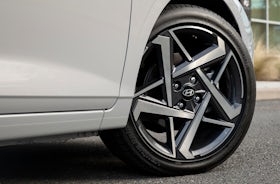
The top-of-the-range i20 Tech Line starts at just over £24,000, but for that it comes with automatic air conditioning, very swanky 17-inch alloy wheels, keyless entry-and-go, a centre console armrest, chrome exterior trim and powerfold side mirrors. The equivalent Renault Clio costs less, however, and it’s a better all-rounder than the i20.
Performance and drive comfort
Hyundai has covered all the bases with the i20, but it’s not quite as much fun as a Ford Fiesta or as quiet as a VW Polo
In town
There’s a lot to like about the Hyundai i20 when you’re driving around town. For starters, it has a tight turning circle, so you can weave past obstacles quickly or make a U-turn without having to make multiple stabs at it.
Every i20 comes with rear parking sensors and a reversing camera as standard, which is better than most others of this size and price. Small windows in the rear pillars help when backing into a space, while the front pillars don’t impede vision when pulling out of junctions.
The 100hp 1.0-litre turbo petrol engine has plenty of get up and go, and the standard six-speed manual gearbox has a really good feel to it. Or, you could go for the seven-speed double-clutch automatic, which is smooth and makes slow-moving traffic hassle-free.
In traffic, you’ll notice the mild hybrid system used in all i20s often switches the engine off as you coast to a halt to save fuel. The Hyundai can also pull away using battery power before the petrol motor cuts in imperceptibly.
Where the i20 is not so impressive is the comfort and how it deals with bumps. It just feels as if Hyundai has started with a sporty setting and forgotten to ease it off for anything that’s not a sporty N Line model. The outcome is you feel a few too many lumps and humps, and the i20 doesn’t fully settle into its stride like a Renault Clio.
On the motorway
The firm suspension of the Hyundai i20 in town has an upside when you head on to the motorway as the car feels more than able to hold its own among trucks and vans.
The firmness at lower speeds eases away and the i20 feels controlled and composed. You also have lane keep assist and Forward Collision Avoidance, plus automatic emergency braking to ward off any potentially dangerous situations.
It’s not all comfort and joy, though, as there’s too much wind and road noise inside the i20’s cabin.
The 100hp 1.0-litre engine has just enough puff to cope with motorway driving, but you will need to drop down a gear or two to accelerate at a decent pace to join off the slip road or get up hills easily.
On a twisty road
The Hyundai i20 is so close to being a lot of fun on back roads that it’s a bit annoying it doesn’t quite finish the job.
The problem lies in the steering, which just doesn’t feel very connected to the front wheels. It turns the car in just fine and the i20 holds its line perfectly well with lots of grip, but the driver just isn’t aware of much of what’s going on. The Mazda 3 manages to be good fun to drive, so it’s frustrating the i20 doesn’t measure up.
When you're pressing on you might also be annoyed by the lack of feedback through the clutch. Fast gearchanges just don't feel as satisfying as they could.
Still, the firm-ish suspension keeps body lean from ever being an issue, though you will hear changes in road surface quality all too often.
Space and practicality
One of the best cars of this size for passenger space and carrying ability, it’s just a pity the Hyundai i20 doesn’t have more flexible options in the load bay
Hyundai has made a cracking job of the i20’s driving position. You get a height-adjustable seat in all models, and the steering wheel moves for both height and depth. It makes it super easy to find the right seat set-up no matter what size you are.
There are a couple of minor points to bear in mind, though. For starters, the i20 doesn’t come with any sort of lumbar adjustment, though the front seats do offer good support.
However, the controls are all ideally in line with the driver when you’re sat in the Hyundai, and there’s good all-round vision as the front pillars are not too thick.
Rear parking sensors and a reversing camera are fitted to all i20 trims, so it’s a doddle to park.
Big door bins take care of water bottles, and there are two cupholders in the console between the front seats. Here, you’ll also find a cubby with a lid that moonlights as an armrest, too.
There’s more storage in front of the gear lever, where Hyundai has fitted a 12-volt charger and USB port to work with your phone. In the Ultimate trim, this pad works as a wireless phone charger.
In the glovebox, there’s a bit of extra space for small items alongside the car’s owner’s manual.
Space in the back seats
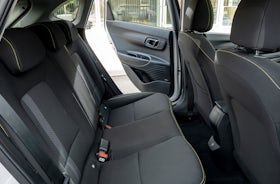
The i20 offers more rear seat space than many other small hatchbacks. You get plenty of head, leg, knee and shoulder room.
For anyone sat in the middle of the rear bench, there’s still just about enough space for feet, but you will definitely be rubbing shoulders with the people on either side of you.
A trio of triple-point seat belts are fitted to the i20, and there are ISOFIX mounts in the two outer rear seats. It’s not as quick to access these secure mountings as in some others as you have to poke the kiddy seat’s lugs into the fabric of the seat to find the brackets.
With a child seat fitted, you might need to move the front seats forward a bit.
Door bins offer plenty of storage space, and there’s a map pocket on the passenger side. Hyundai also includes a small angled tray to stash a mobile phone in, with a USB conveniently placed just below for charging.
Boot space
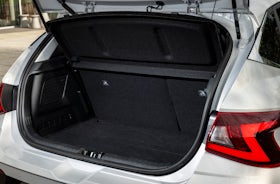
With 352 litres of boot space with the rear seats up, the Hyundai i20 has a single litre more carrying capacity than a Volkswagen Polo. What that means in the real world is the i20 has a decently big boot for this type of car. It's not anywhere close to the Renault Clio's 391 litres, though.
The floor can be adjusted to two different heights, and in its higher setting it just about sits flush with the load sill.
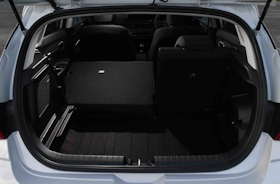
The rear seats split 60-40 and tip forward easily, but there’s none of the cleverness of the Honda Jazz in here. Instead, Hyundai simply offers a maximum boot capacity of 1,165 litres, so it’s good without being the best in the class.
Interior style, infotainment and accessories
The i20 is well made and well equipped, but not everyone will appreciate Hyundai’s styling or the scratchy plastics
There’s no doubt the Hyundai i20 will last for a long time and put up with all the usual trials of life, but why did they have to use so many hard, cheap-looking plastics in the cabin?
Everywhere you look and feel, Hyundai seems to have used a stock of scratchy plastic that makes the i20’s cabin appear less appealing than a Volkswagen Polo’s or Skoda Fabia’s.
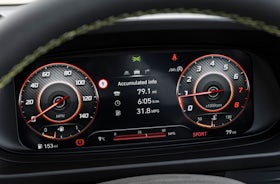
Luckily, the person put in charge of the controls was a much more sensible individual. They came up with clear, easy to read digital dials for the main instruments and they’re standard on all trim levels. There’s also a small information cluster between the main dials that you can scroll through menus with to see various bits of data about your journey or the car’s well-being.
In the middle of the dash, there are quite a few buttons to work the heating and ventilation, but it’s not too bad to use once you’re used to it.
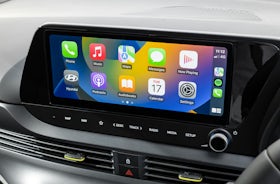
Much better is the infotainment system in the i20. The 8.0-inch touchscreen on most models works easily with Apple CarPlay and Android Auto, and if you didn’t know any different you’d be very happy with its clear graphics and quick responses.
However, Hyundai has kept an ace up its sleeve with the 10.3-inch touchscreen used in the i20's upper trims. Its big, bright display is ideal to use while driving, and there are shortcut buttons to take you straight to the most used menus.
There’s even a rotary dial close to the driver’s left hand to change the stereo volume in an instant instead of the slightly small steering wheel buttons.
MPG, emissions and tax
Hyundai i20 fuel economy is good without being stellar. Manual models return an official 53.2mpg combined, while that figure's reversed in the automatic, offering 52.3mpg.
In practice, we found that steady motorway cruising yielded around 50mpg in the manual, which is on par with most of the petrol-powered competition. However, it's much less than you'd get in a Toyota Yaris or Renault Clio Hybrid.
Hybrid alternatives also offer lower CO2 emissions - the i20's are 120g/km and 122g/km for the manual and the automatic versions respectively.
Every i20 falls into the same road tax bracket, which is £210 for the first year, while company car tax is reasonable as well - just not as affordable as a hybrid or electric vehicle, so you’re better off looking elsewhere for a bargain Benefit-in-Kind rate.
Safety and security
When Euro NCAP tested the Hyundai i20 in 2021 it scored four stars. That's the same score as the Vauxhall Corsa and Peugeot 208, though the VW Polo and Renault Clio both have five-star ratings. The scoring criteria has become much stricter since the i20 was tested though, so there's no telling how it would stack up against more modern alternatives
There’s no shortage of safety kit as standard for the Hyundai i20. Every car comes with six airbags, automatic emergency braking, lane keep assist, and Forward Collision Avoidance.
You also get eCall, Intelligent Speed Limit Warning, and a driver fatigue alert.
Go for the Premium trim and you also benefit from a blind spot warning, Forward Collision Avoidance for junctions, and Lane Follow Assist.
Reliability and problems
With a 20th place finish in the 2025 Driver Power survey for owner satisfaction, Hyundai sits firmly in the lower half of the 32 manufacturers entered into the mix. Not the most promising result, but Hyundai is confident enough in its i20 to supply it with a five-year, unlimited mileage warranty as standard.
That exceeds most alternatives, unless you pay extra for their extended warranties, but still can’t come close to Toyota and Suzuki with their ten-year, 100,000-mile coverage.
Hyundai i20 FAQs
- Cash
- £18,133
- Monthly
- £210*
- Used
- £8,799
Configure your own i20 on Carwow
Save on average £2,878 off RRP
Popular Hyundai i20 transmissions
Popular Hyundai i20 colours
*Please contact the dealer for a personalised quote, including terms and conditions. Quote is subject to dealer requirements, including status and availability. Illustrations are based on personal contract hire, 9 month upfront fee, 48 month term and 8000 miles annually, VAT included.