Nissan Qashqai Review & Prices
The Nissan Qashqai is a striking, spacious family SUV with lots of standard kit and a great hybrid engine, but the the boot could be bigger and there’s no plug-in option

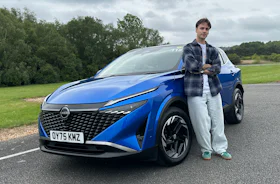


- Cash
- £25,482
- Monthly
- £248*
- Used
- £9,895



What's good
What's not so good
Find out more about the Nissan Qashqai
Is the Nissan Qashqai a good car?
The Nissan Qashqai was one of the first examples of the modern-day family SUV as we know it, and it’s still one of the best. It’s a very sensible and comfortable take on the recipe with a practical interior and handsome styling, but most alternatives have bigger boots.
It’s a great, family-friendly option that’s just interesting enough to turn a head or two on the school run, without compromising much on its practicality.
Think of the Qashqai as Robbie Williams, if you will. It’s about as mainstream as you can get and it’s been around for ages, so it’s easy to forget that it’s actually really good. It’s not the only mainstream choice that’s trying to top the charts, however.
Whether it’s the Volkswagen Tiguan, Citroen C5 Aircross, Dacia Bigster or Kia Sportage, there are plenty of household names producing similarly-sized family SUVs at the moment. You could also look to the younger upstarts such as the Omoda 7, Chery Tiggo 7, Jaecoo 7 or Geely Starray which offer even more standard kit for a similar - or cheaper - price.
Step inside and you’ll find an interior that’s neither particularly striking nor too bland, but most importantly, it’s practical enough to deal with most day-to-day situations. Tall occupants won’t struggle for space both front and back, and there are plenty of spaces to hide smaller odds and ends away.
Nissan has catered towards passengers more than cargo, as the 504-litre boot is smaller than what you get in a Tiguan or a Hyundai Tucson. That’s the trade-off for the generous rear leg room.
The Qashqai doesn't have the biggest boot but it's good-looking, comfortable and has a great hybrid engine option
Where the Qashqai excels is in common sense and ease-of-use. Whereas the Jaecoo 7, Peugeot 3008 and Ford Kuga are very touchscreen-reliant, there are plenty of physical buttons which are far more intuitive to use on the move in the Nissan. The built-in Google software is a joy to operate, too.
The Nissan sits somewhere between all of the above in its mix of size and sensibility, and that extends to the design, too. It’s sharper to look at than ever, with a massive grille and slender headlights that appear stretched towards the cabin, almost as if it’s being warped by speed. Yet the rest of the Qashqai is pretty uneventful to look at, if inoffensive.
There are two engines to choose from: an entry-level 1.3-litre mild hybrid petrol which comes in manual or automatic guise. You’ll see around 40mpg in daily use and it’s an otherwise adequate piece of kit.
It’s the e-Power hybrid that really impresses, as the petrol engine acts as a generator for the electric motor, rather than powering the wheels directly. That means it’s as smooth and nippy as an EV - and the smoothness that goes with it - but with the peace-of-mind of a petrol engine for range.
All Qashqais are composed and comfortable to drive, that being said. It deals with speedbumps and potholes very well, and there’s little road and wind noise on the motorway. Don’t expect any fun on a country lane, though, but you’ll have enough confidence to carry speed through tight corners.
Verdict
Don’t expect any stand-out traits - aside from the sensible cabin - but the Qashqai is a brilliant choice of all-rounder. If all you need is a practical and easy family car for school runs and road trips you won’t go wrong with it, even if a Citroen C5 Aircross is more stylish and a Ford Kuga is sportier to drive.
Like what you’ve read? Check out the latest Nissan Qashqai deals on Carwow, or find a used Nissan Qashqai for sale here. You can check out other new Nissan deals or used Nissans for sale too, and remember that Carwow can help you to sell your current car too.
Nissan Qashqai: size, practicality and storage
Dimensions (length, width, height in mm): 4,425 x 1,835 x 1,625
Number of seats: five
ISOFIX points: two (outer seats, second row)
Boot space seats up: 436 litres (subwoofer-equipped cars), 504 litres
Boot space seats down: 1,447 litres
Towing capacity: 750kg (hybrid), 1,400kg (front-wheel drive), 1,800kg (four-wheel drive)
How much is the Nissan Qashqai?
The Nissan Qashqai has a RRP range of £30,635 to £42,735. However, with Carwow you can save on average £6,248. Prices start at £25,482 if paying cash. Monthly payments start at £248. The price of a used Nissan Qashqai on Carwow starts at £9,895.
Compare Nissan Qashqai trims and prices:
| Nissan Qashqai trim and price | |
|---|---|
| 1.3 DiG-T MH 158 Acenta Premium 5dr - Price from £31,145 |
Explore latest deals
|
| 1.5 E-Power 205 Tekna 5dr Auto - Price from £39,165 |
Explore latest deals
|
| 1.5 E-Power 205 Acenta Premium 5dr Auto - Price from £34,385 |
Explore latest deals
|
| 1.5 E-Power 205 N-Connecta [Glass Roof] 5dr Auto - Price from £37,705 |
Explore latest deals
|
| 1.5 E-Power 205 Tekna+ 5dr Auto - Price from £42,735 |
Explore latest deals
|
| 1.5 E-Power 205 N-Connecta 5dr Auto - Price from £36,855 |
Explore latest deals
|
| 1.3 DiG-T MH 158 Acenta Premium 5dr Xtronic - Price from £32,965 |
Explore latest deals
|
| 1.5 E-Power 205 Tekna [Bose] 5dr Auto - Price from £39,815 |
Explore latest deals
|
| 1.5 E-Power 205 N-Design 5dr Auto - Price from £39,165 |
Explore latest deals
|
| 1.3 DiG-T MH 158 N-Connecta [Glass Rf] 5dr Xtronic - Price from £36,285 |
Explore latest deals
|
The Qashqai range starts at just over £30,000, so it’s undercut by the Dacia Bigster and MG HS but on a par with or significantly cheaper than most other alternatives. The hybrid e-Power model weighs in at just under £35,000 - again, undercut by the Dacia and MG but cheaper than most proper hybrids.
The basic Acenta Premium model is best avoided - it gets dual-zone climate control, wireless smartphone connectivity and keyless entry, but misses out on that proper Google-based infotainment system. Plus, its small alloy wheels and cloth seats look rather plain. Mid-spec N-Connecta is much more attractive with 18-inch wheels, the Google system, a wireless charger and 360-degree camera setup.
Models at the top of the range are knocking on £40,000 but do get 20-inch wheels, quilted leather seats with a massage function, Bose sound system and upgraded suspension - but at that price, you might be better off buying a car with a posher badge.
We’d recommend going for an N-Connecta model with the e-Power hybrid engine as the best blend of value, economy and equipment.
We’ve tested two Qashqai models recently - a mild hybrid in N-Connecta trim and a posher e-Power full hybrid in Tekna trim. We loved the e-Power engine, it’s a much better option than the mild hybrid - but the extra equipment of the Tekna trim nudges it over £40,000, and that’ll cost you a lot in road tax in years two to six of ownership.
Space and practicality
My 6’2” frame tests the extremes of the driver’s seat adjustment
The Qashqai’s roomy and well-thought-out interior offers plenty of practical touches, although alternatives like the VW Tiguan have a larger boot
Space in the front seats
Most drivers ought to be able to get comfortable up front, though the seats don't quite have the range of adjustment of a Skoda Karoq. Our 6'2" tester had his seat as far back as it would go, and the steering wheel would be better if it could adjust a bit further too.
Space in the back seats
In the rear, the two outer seats will comfortably accommodate adults, while the central one will be best left for children or teenagers. Legroom is pretty good – better than in the old Qashqai, but not as good as in the Tiguan – and headroom is generous too, even if you have the panoramic sunroof fitted. The rear doors open 85 degrees wide, aiding ingress, egress and loading in child seats.
ISOFIX points
The Qashqai is unremarkable for child seat safety, with only two ISOFIX anchor points in the outermost rear seats. The ISOFIX points sit beneath a small latch, and the bonus of good legroom means we found our bulky rear-facing child seat could fit in without having to push those in the front forward.
Boot space
Compared to alternatives like the Kia Sportage and Volkswagen Tiguan, the Qashqai falls a bit short in terms of boot space. With 504 litres compared to the 591 litres of the Sportage and 615 litres in the Tiguan, you may need to leave a bag behind, but it’s still spacious enough to take a baby stroller and a couple of squishy bags.
You can now specify an electrically-operated tailgate, which makes loading easier when you’re carrying armfuls of shopping, as does the low load lip. Fold the rear seats down and you get 1,539 litres of space, still less than the Sportage and Tiguan, but the boot floor is flat and wide so you can make the most of the space available.
N-Connecta models have a configurable boot floor, however this takes boot space down to 479 litres. If you take the Tekna+ model the Bose sound system’s amplifier further impinges on boot space, so you get just 436 litres. Hooks, tethering points and a 12-volt socket are provided across all models.
Interior storage and accessories
Cupholders, door bins, glovebox, phone storage, sliding seats, tables, etc. Check configurator for optional stuff like roof box, tow bars, extra storage features
Front passengers in the Qashqai can make use of a set of large cupholders set into the centre console as well as generous door pockets which will take big water bottles as well. Gotta stay hydrated these days.
Two different types of USB ports and a 12-volt plug point are provided ahead of the stubby gear lever, and you can place personal items out of sight in the smallish glovebox or the more generously proportioned central bin. There's also a wireless charging pad on most models, with a lip to keep your phone secure.
For back seat passengers, two scoops in the door pockets will take a pair of water bottles. The fold down central armrest incorporates some rather flimsy cupholders as well.
Interior style, infotainment and accessories
The Google software is the highlight of an otherwise boring, but pleasant, interior
The Qashqai’s fantastic Google software makes it as easy to use as a smartphone, but the design isn’t very exciting
The Qashqai’s interior isn’t particularly glamorous, but it’s built of nice materials and it’s also really easy to use - which is much more important. It doesn’t have the wow factor of something like a Peugeot 3008, but the improvements that came with the 2024 facelift do add in some fetching metal-effect trim on the centre console and a huge swathe of Alcantara suede across the dashboard, both of which are very pleasant.
All Qashqais now come with a large, 12.3-inch touchscreen infotainment system. On base cars, the feature list is pretty standard but all other trims have a full suite of Google-powered upgrades. The most important of these is built-in Google Maps - far superior to most built-in sat-navs in terms of accuracy, updates, and ease-of-use.
You also get access to the Google Play Store which means you can download additional apps, such as Waze for navigation, Spotify for music or your favourite podcast app.
The screen is big and clear, but once you’re out of the Google-specific apps it’s not the most straightforward to navigate. The same goes for the 12.3-inch digital instrument cluster, which isn’t particularly attractive and can be a bit of an information overload. It’s a shame this can’t display maps in full screen like the VW Tiguan’s system can.
Underneath the touchscreen you’ll find a full panel of climate controls, which is great to see - so many new cars have these either partially or completely operated through the touchscreen, which isn’t much fun to do on the move. There’s even a few useful shortcut buttons immediately above these, including one to dim the touchscreen for night driving and a shortcut to the Qashqai’s 360-degree camera system.
Overall build quality is good - who’d expect less from a car built in Sunderland? Apart from the nice fabric panel, there are some pleasantly squidgy plastics atop the dashboard and the doors, but you don’t need to look too far to find scratchier ones. That’s par for the course in a car like this, though, and even the cheap materials feel hard-wearing.
Performance and drive comfort
I wouldn't use the Qashqai to attack a country lane, but it's surefooted enough
The Nissan Qashqai is easy to drive with good visibility and light controls, plus the e-Power hybrid is fantastic - it just isn’t very exciting on a twisty road
Driving the Qashqai round town is a doddle. You sit up nice and high, with lots of adjustment in the seating position and steering column, so it’s easy to get comfortable. Visibility is decent, even over the shoulder, and the 360-degree camera system being standard from the good-value mid-spec trim is a real boon when it comes to parking.
The mild hybrid engine has enough pickup from low speeds, but the manual gearbox has a long throw and feels rubbery, while the optional automatic is a bit hesitant out of junctions - though the e-Power avoids this. The suspension does a reasonable job of dealing with bumps, but a Citroen C5 Aircross is much more comfortable.
The e-Power is again the best here, and since its 2025 update even gets pretty good fuel economy at a cruise - we found that the older version struggled to top 35mpg on a motorway run. Now 55mpg+ is much more achievable, as we found out during our commute.
There’s a little bit of tyre noise, especially on the bigger wheels, but it’s not too bad. Nissan’s assisted driving tech is also fine - it’s not as smooth in operation as the systems on the Skoda Karoq or Kia Sportage, but it’s better than the slightly clunky system on a Peugeot 3008.
The Qashqai is very neutral to drive on a twisty road. It doesn’t lean too much in bends, and the steering is accurate, but there’s very little feedback through the wheel or the driver’s seat. It doesn’t encourage you to press on in the way that a Ford Kuga or Mazda CX-5 does; best driven in a more relaxed fashion, where you can enjoy the comfortable suspension.
Reliability and problems
| Make and model | Warranty cover |
|---|---|
|
Nissan Qashqai |
Three years, 60,000 miles |
|
Dacia Bigster |
Seven years, 75,000 miles |
|
Citroen C5 Aircross |
Three years, 60,000 miles (eight years/100,000 miles on drivetrain components)* |
*The standard warranty is extended by a year each time the vehicle is serviced at an approved location
The Qashqai has regularly topped the medium-sized SUV sales charts and yet the previous model was not considered the last word in reliability by owners. The new model feels considerably more substantial and well-built, addressing many of the concerns raised with the older Qashqai.
It’s too soon to tell how it will fare in the reliability stakes, but everything seems to point to a much-improved product. There have been two minor recalls so far, with one being for a steering assist system that can cause a noise while in operation.
Nissan was pretty much bang smack in the middle of the 2025 Driver Power owner satisfaction survey, coming 15th out of 31 manufacturers.
A pretty standard three-year/60,000-mile warranty is offered here, with the opportunity to extend coverage as long as the car is less than 10 years old and has covered under 100,000 miles. The dedicated EV components also come with their own five-year/60,000-mile warranty.
Safety and security
Nissan Qashqai Euro NCAP rating (2025): 4/5
Adult occupant: 78%
Child occupant: 85%
Vulnerable road users: 65%
Safety assist: 62%
For a family car it’s a little disappointing that the Qashqai didn’t achieve a full five-star Euro NCAP safety rating - low scores for vulnerable road users and safety assist features contributed to that, though the crash test scores weren’t too bad.
In fact we find the Qashqai’s safety systems actually work better than most on the road. Adaptive cruise control that operates smoothly and a rear parking camera are standard across all models, and Nissan’s semi-autonomous driving aids work really well too. Plus, you can silence the more annoying excesses of safety regulations with just two presses of a button, which is always a bonus to stop the annoying bonging and beeping all the quicker.
MPG, emissions and tax
There are a couple of engine options for the Qashqai. The base models get a 1.3-litre mild hybrid petrol engine with 140hp and a six-speed manual gearbox. There’s also a 158hp version of this engine available, which can be had with a manual or a CVT automatic. The official figures are 44.8mpg for the 140hp manual, 45.6mpg for the automatic and a superb 64.2mpg for the e-Power hybrid.
In our time with the 140hp manual, we averaged around 40mpg - about what you’d expect from a fairly large, petrol-powered SUV, but nothing particularly groundbreaking. A 150hp Skoda Karoq would return similar economy.
If you want the ultimate in penny-pinching you should go for the e-Power hybrid. This is a unique system, which instead of using the engine to drive the wheels simply uses it as a generator to charge the battery. All the driving is done by an electric motor.
In our testing we actually saw over 60mpg from this system, even on long motorway runs - an area where hybrids often suffer. That’s better than you’ll get from a Citroen C5 Aircross Hybrid, a Kia Sportage Hybrid or a Ford Kuga Hybrid. When we tested the Qashqai alongside a Dacia Bigster, though, it came close to 70mpg.
The e-Power also has the lowest CO2 emissions, at just 102g/km. This means cheaper first year road tax than the mild hybrids, and more favourable company car tax rates - though it’s not anywhere near as cost-effective in terms of Benefit-in-Kind as a plug-in hybrid alternative would be.
Nissan Qashqai FAQs
Nissan Qashqai owner reviews

- Cash
- £25,482
- Monthly
- £248*
- Used
- £9,895
Configure your own Qashqai on Carwow
Save on average £6,248 off RRP
Popular Nissan Qashqai transmissions
Popular Nissan Qashqai colours
Nissan Qashqai cars by city
Nissan Qashqai car comparisons
*Please contact the dealer for a personalised quote, including terms and conditions. Quote is subject to dealer requirements, including status and availability. Illustrations are based on personal contract hire, 9 month upfront fee, 48 month term and 8000 miles annually, VAT included.