Nissan Juke Review & Prices
Quirky styling and decent kit levels aren’t quite enough to balance out the Nissan Juke’s bouncy suspension and tight cabin




- Cash
- £19,373
- Monthly
- £229*
- Used
- £7,999



What's good
What's not so good
Find out more about the Nissan Juke
Is the Nissan Juke a good car?
The Nissan Juke has been on sale for a while now, and it’s still as polarising as when it was launched. It’s a reasonably-priced small SUV with head-turning looks and decent standard kit, but it’s neither very spacious nor is it very comfortable.
Honestly, it’s a bit like the pug of the car world. Some people love it for its styling and quirkiness, but beyond that it’s just not as functional as its larger alternatives.
That being said, the Juke isn’t the only striking little SUV on sale anymore, with the Peugeot 2008, Renault Captur, Jaecoo 5 and electric MG4 hatchback all featuring interesting exterior designs. They’re all more practical than the Juke, too.
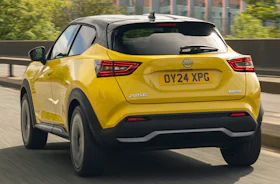
Back to the looks, and the little Nissan - while no longer outrageous - is still iconic thanks to its big, round headlights, topped by slender running lamps at the front, a low roofline in the middle and an aggressive bumper at the back. Is it a good looking car? Maybe, even now it’s hard to tell, but it’s definitely a way to stand out in traffic.
Don’t expect quite as many outrageous lines and curves in the Juke’s cabin, even though it does feature a pleasant wraparound dashboard which flows on to the door cards, as well as widescreen infotainment system perched in the middle. Material quality, however, leaves a lot to be desired in places. Don’t let that strip of (actually quite nice) Alcantara on the dash fool you, there are lots of hard, scratchy plastics throughout the centre console and door cards.
The Nissan Juke is loaded with character, but it's not quite as well rounded as more sedate alternatives
It’s not the design which is the Juke’s biggest issue inside, but the space - or lack thereof. Even from the driver’s seat the Nissan feels snug, though there’s a surprisingly high seating position for such a small SUV. The back, however, isn’t a welcoming place for adults to sit for any period of time, and the 422-litre boot isn’t anything to brag about. The Ford Puma offers far more cargo capacity.
There are two engine options. The entry-level 1.0-litre engine is paired with a manual or an automatic gearbox, while the more powerful 1.6-litre hybrid automatic is smoother than the petrol.
Around town the Juke is appropriately easy to drive, with light steering and decent forward visibility. Your over-the-shoulder view is poor, however, and the engines are noisy when you give the Juke a stab of the throttle. It’s woefully uncomfortable, too.
It settles down a touch at higher speeds, but it still bounces over motorway dips and feels totally out of place on a twisty road. Keep the Juke in town, where it's at its best.
Verdict
The Nissan Juke is as much a novelty as it is a sensible little SUV - because it isn’t actually all that sensible. Sure the engines are economical, but the Juke is far less spacious than a Ford Puma, worse inside than a Volkswagen T-Cross and the hybrid system isn’t as efficient as in a Toyota Yaris Cross. Styling alone isn’t enough to recommend the Nissan over its alternatives.
Browse the latest Nissan Juke deals on Carwow, as well as Juke lease deals or used Jukes available through our trusted dealer network. There are loads of other used Nissans for sale and Carwow can even help you sell your current car when it’s time to switch.
How much is the Nissan Juke?
The Nissan Juke has a RRP range of £23,635 to £31,295. However, with Carwow you can save on average £4,806. Prices start at £19,373 if paying cash. Monthly payments start at £229. The price of a used Nissan Juke on Carwow starts at £7,999.
Compare Nissan Juke trims and prices:
| Nissan Juke trim and price | |
|---|---|
| 1.6 Hybrid Tekna+ 5dr Auto - Price from £31,115 |
Explore latest deals
|
| 1.0 DiG-T Acenta Premium 5dr [Revised] - Price from £23,635 |
Explore latest deals
|
| 1.6 Hybrid N-Connecta 5dr Auto [Revised] - Price from £28,815 |
Explore latest deals
|
| 1.0 DiG-T N-Connecta 5dr [Revised] - Price from £25,715 |
Explore latest deals
|
| 1.0 DiG-T Acenta Premium 5dr DCT [Revised] - Price from £25,485 |
Explore latest deals
|
| 1.6 Hybrid Pulse Edition 5dr Auto - Price from £30,115 |
Explore latest deals
|
| 1.0 DiG-T Tekna+ 5dr - Price from £28,015 |
Explore latest deals
|
| 1.0 DiG-T Tekna+ 5dr DCT - Price from £29,865 |
Explore latest deals
|
| 1.0 DiG-T N-Connecta 5dr DCT [Revised] - Price from £27,565 |
Explore latest deals
|
| 1.0 DiG-T Pulse Edition 5dr - Price from £27,015 |
Explore latest deals
|
The Nissan Juke entry price is targeted at the lower end of the scale, making it one of the cheaper options in its class. However, once you begin to look at higher-spec versions, that quickly starts to climb — going beyond the Skoda Kamiq and sitting alongside the Volkswagen T-Roc. The top-spec hybrid model costs in excess of £30,000, making it a very hard sell.
Even the cheaper versions aren't fantastic value. While the entry-level Acenta Premium car does come with quite a lot of equipment, a cheaper Volkswagen T-Cross or equivalent Toyota Yaris Cross are vastly nicer to drive. You'd really have to love the Juke's looks for it to be worth the money.
Performance and drive comfort
The Nissan Juke’s noisy engines frustrate me massively around town…and on the motorway
The Nissan Juke is simple to drive in most conditions, but does lack the fun a Ford Puma can offer
In town
With most Nissan Jukes set for a lifetime of running around town, it’s no surprise to learn this is where it’s best suited. A high-set driving position means you’ve got a good view of the road ahead, and suitably light steering makes it a breeze to park.
You do have to contend with pretty poor rear visibility, however. All cars get a reversing camera to help with this.
What can't really be helped is the way the Juke deals with bumps in the road. All models, but particularly those on the largest 19-inch wheels, seem to pick up every imperfection in the tarmac and are very uncomfortable over potholes and speed bumps.
For the most effortless way of getting out of junctions, go with one of the hybrid cars. The response from the engine and gearbox is much better than the standalone petrol’s dual-clutch automatic, and the manual gearbox’s clutch isn’t great to use either.
On the motorway
With cruise control and a whole load of other safety tech as standard, the Nissan Juke is pretty well equipped to take motorways on. That said, it’s again compromised in comfort. Not only does the suspension not really settle down, but both engines are pretty noisy.
The hybrid in particular can get stuck at a certain rev range depending on your speed - feeling and sounding endlessly like it needs to change up a gear. It can become quite unpleasant. There's a fair amount of wind and road noise, too.
Higher-spec cars also come with Nissan’s Pro Pilot suite of tech. This upgrades your cruise control to an adaptive system, allowing the Juke to automatically adjust its speed to maintain a distance from a car ahead.
On a twisty road
Don’t expect to get too much fun out of a Nissan Juke on a back road, which in fairness it’s not designed for.
The lifeless steering doesn't really give you any feedback about what the front wheels are doing, and it soon runs out of grip going into a corner.
It does 'feel' a bit sportier than some alternatives thanks to the firm suspension, but the loss of comfort isn't a price worth paying in our view.
Space and practicality
I’m not even that tall and I struggle in the back of the Juke
The Nissan Juke has lots of quality, but not a massive amount of space for passengers or your stuff
Though you do sit quite high in the Juke, giving you a decent view out of the front, there’s a bit of a cramped feeling inside. It’s not uncomfortable, but if you want more space to stretch out, the likes of the Skoda Kamiq and Volkswagen T-Cross will appeal more.
You do have some decent storage spaces, though. Door bins are big enough to take a decent-sized water bottle, and there’s a tray to store your phone integrated within the centre console — although bigger phones may struggle to stay in there.
Space in the back seats
While the latest Nissan Juke offers a bit more space in the back than the old car, it’s still pretty poor. If you want to use the rear row for anything more than carrying children in car seats, your occupants might be in for a long ride.
Legroom is pretty poor, and the sloped roofline cuts notably into headroom too. There’s also quite a considerable hump on the floor, so anyone sitting in the middle seat is going to have nowhere for their feet. And those high-set door handles are positively awkward, especially if your children would like to get into the car by themselves.
Boot space
With 422 litres to work with, the Nissan Juke is pretty much par for the course in its class. For context, a VW T-Cross takes the cake with 455 litres, while the Renault Captur matches the Juke. A Skoda Kamiq offers less than all of these at 400 litres.
You need the load floor in its higher position if you want it to be level with the 60-40 split-and-fold rear seats when they are tipped forward. With this done, the Juke has up to 1,305 litres of load capacity, which is among the best among its peers.
It’s a shame, then, Nissan doesn’t offer more in the way of tie-down points in the boot or even a 12-volt charger.
Interior style, infotainment and accessories
The dashboard looks nice, but the infotainment is a bit of a faff to get around
The latest Juke's interior feels good up top, though you don't have to stray far to find cheap materials
For all of the outlandish exterior styling, the interior of the Nissan Juke seems pretty tame - albeit that’s no bad thing. The 2024 update gave it a far more grown-up feeling to it, with a new infotainment system, new materials and a total redesign.
The most noticeable addition is a swathe of Alcantara fabric across the top of the dash. This does feel really nice, especially as this suede-like material used to be the preserve of sports cars only. However, underneath this the Juke's interior still makes do with a lot of hard, scratchy plastics, and you can tell where pennies have been pinched by some of the smaller touches - the halogen bulbs in the dome lights, for example, or the lack of a light on the vanity mirror.
All versions of the Juke are equipped with a 12.3-inch touchscreen infotainment system. This is a big improvement on the setup previously fitted to the Juke - it's clear, bright and responsive, though certain aspects of the interface are a bit difficult to use. The settings panel in particular is a labyrinth of menus and you might not find what you're looking for straight away.
On the plus side, it does come equipped with Android Auto and Apple CarPlay - allowing you to seamlessly run your phone apps through the screen.
Higher-spec models also get a new digital dial display, which looks good but doesn't offer the configurability of the system in, say, a Volkswagen T-Cross.
MPG, emissions and tax
There’s a choice of two engines for the Nissan Juke. The first is a 1.0-litre turbocharged three-cylinder engine, producing 114hp. Official tests have this spec of Juke as returning up to 48.7mpg in manual guise (47.1mpg in the automatic) with CO2 emissions of 131-136g/km.
You can opt for a self-charging hybrid too, which links a 1.6-litre four-cylinder petrol engine to an electric motor. It recharges a small-capacity battery using the engine, as well as from waste kinetic energy while braking - a process known as regenerative braking. Official tests of this Juke give it an impressive figure of up to 60.1mpg and CO2 emissions of 106g/km
Company car drivers will be better off with a plug-in hybrid or electric alternative, such as the Peugeot E-2008, which will fall in a cheaper rate of Benefit-in-Kind duty than the Juke. The reasonably low emissions figure puts the little Nissan in the lower half of the road tax scale for private buyers.
Safety and security
Nissan Juke Euro NCAP Score (2019): 5/5
Adult occupant: 94%
Child occupant: 85%
Vulnerable road users: 81%
Safety assist: 73%
When the Euro NCAP safety board last tested the Nissan Juke, in 2019, it awarded it its full score - five out of five stars. It’s worth noting that the test has become stricter in the years since, though.
With safety technology like lane departure warning, automatic emergency braking and high beam assistance included as standard, there’s plenty to back that safety score up.
Nissan has even come up with a good solution for the latest EU-mandated safety equipment. All you have to do is set up your 'personal' profile of safety settings, where you can opt to turn off the speed limit warning and lane-keep aids if you wish. Then, it's just two button presses to turn it on at the start of each drive.
Reliability and problems
| Make and model | Warranty cover |
|---|---|
|
Nissan Juke |
Three years, 60,000 miles |
|
Renault Captur |
Three years, 60,000 miles |
|
Volkswagen T-Roc |
Three years, 60,000 miles |
Nissan came 15th out of 31 brands in the 2025 Driver Power survey for owner satisfaction, one place behind Toyota and eight places behind Peugeot.
From the factory, each Juke is covered by a three-year, 60,000-mile warranty; bog-standard, and again unimpressive when compared to brands such as Kia or Hyundai. Toyota offers a ten-year, 100,000-mile warranty on its cars - so long as you get an annual, dealer-approved service.
Nissan Juke FAQs
Nissan Juke owner reviews

- Cash
- £19,373
- Monthly
- £229*
- Used
- £7,999
Configure your own Juke on Carwow
Save on average £4,806 off RRP
Popular Nissan Juke transmissions
Popular Nissan Juke colours
Nissan Juke cars by city
*Please contact the dealer for a personalised quote, including terms and conditions. Quote is subject to dealer requirements, including status and availability. Illustrations are based on personal contract hire, 9 month upfront fee, 48 month term and 8000 miles annually, VAT included.